
Digital Eye Strain


This is commonly know as "老花“. It is a natural, age-related vision change that affects all of us over time. Much like greying hair or joint stiffness, presbyopia is a normal part of ageing and cannot be prevented.
Around your 40s, these changes often happen gradually, which is why many people don't realize their vision has changed. It's common to assume it's just eye tiredness or normal ageing - until daily tasks like reading, using your phone, or working on a screen become uncomfortable.
However, there are also certain factors that can increase your risk of presbyopia, particularly premature presbyopia (presbyopia that occurs before the age of 40). These risk factors includes :
Diabetes
Multiple sclerosis
Heart Disease
Certain medications
Understanding Presbyopia
So, what exactly is presbyopia?
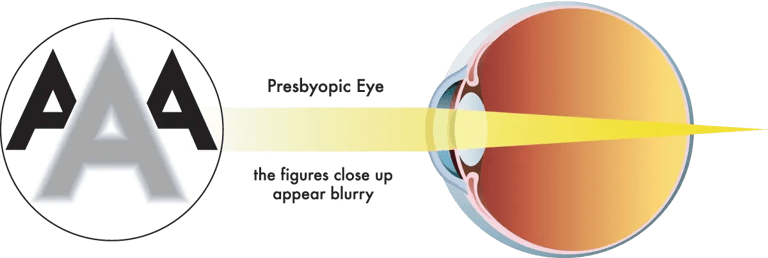
This is commonly know as "老花“. It is a natural, age-related vision change that affects all of us over time. Much like greying hair or joint stiffness, presbyopia is a normal part of ageing and cannot be prevented.
Around your 40s, these changes often happen gradually, which is why many people don't realize their vision has changed. It's common to assume it's just eye tiredness or normal ageing - until daily tasks like reading, using your phone, or working on a screen become uncomfortable.
However, there are also certain factors that can increase your risk of presbyopia, particularly premature presbyopia (presbyopia that occurs before the age of 40). These risk factors includes :
Diabetes
Multiple sclerosis
Heart Disease
Certain medications
Presbyopia happens to everyone, even those with perfect vision before.
Treating
Presbyopia
Progressive Lens
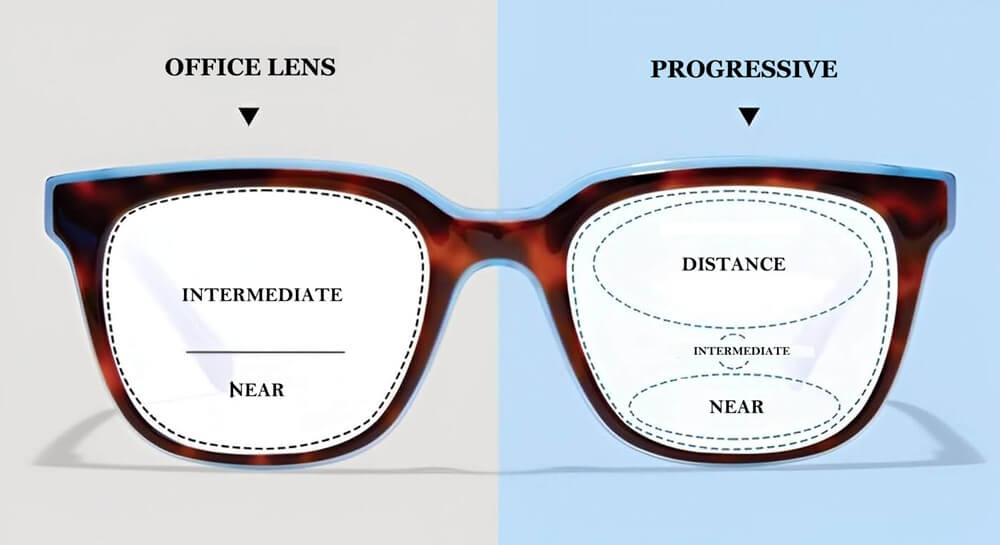
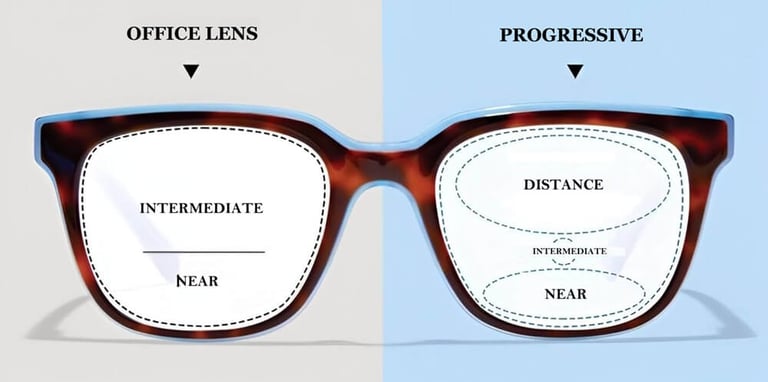
It is also called multifocal lenses. This is an advanced lens thoughtfully designed that helps to see few multiple distances all within a single pair of glasses - without the visible line you get with bifocal lenses. The transitions between distances are gradual and smooth, which many people find it more natural.
Distance Zone - For driving, watching TV, or looking far distance
Intermediate Zone - For computer/laptop works or conversations
Near Zone - For reading, phone use or any close-up tasks
Prescription Reading Glasses
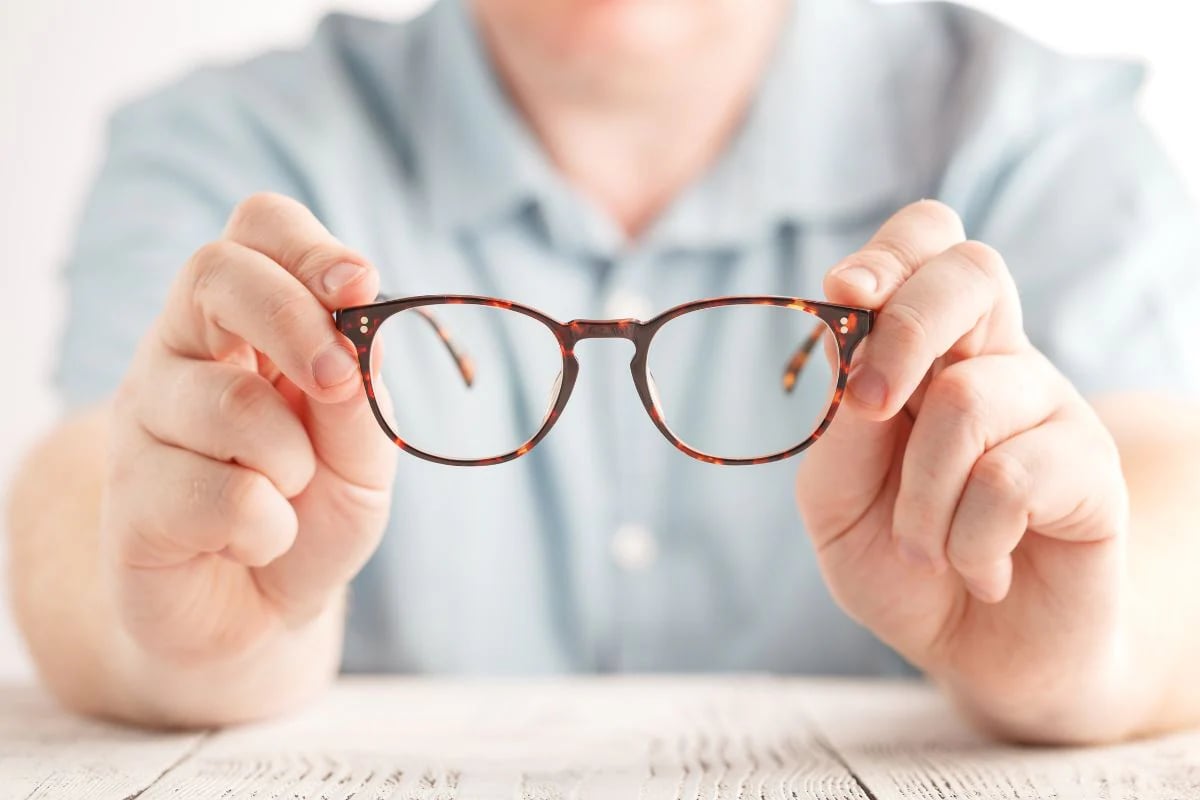
Reading glasses helps you focus on close-up tasks like reading books, labels, or small text from your handphone. They magnify the smaller prints for clearer detail. However, this can only helps for close-up objects, they don't correct distance vision. You often need to take them off and on when moving between near and far tasks (e.g., from reading to talking to someone).
Office Lens
Office lens are special lens designed for indoor work, especially computer and desk tasks. Unlike reading glasses, they're made to give comfortable, clear vision at near (reading) and intermediate (computer) distance - typically from about arm's length up to a 2 meters.
Because the lenses are tailored for your work distances, they can reduce eye strains, headaches and even neck strains that commonly come from constantly shifting focus or awkward head posture. However, office lenses do not include a distance vision, hence, you'll still need another pair of glasses (e.g., distance or progressive) for those tasks. Most people use this lens as a second pair specifically for indoor/work use and have another glasses for daily use.
Progressive lenses feature a smooth change in lens power, which may cause slight blur at the edges and narrower viewing zones compared to dedicated reading or computer lenses. This is more noticeable with lower-quality lenses which can affect the side vision. For optimal clarity and comfort, precise measurements, expert fitting, and high quality lens selection are essential.
While progressive lenses are priced higher than single vision lesnes, premium designs offer smoother transitions, enhanced visual comfort and fewer distortions. With all distances seamlessly combined into one pair, they provide lasting convenience and value without the need for multiple glasses - potentially saving money over time.


Method 1 - Glasses
Prescribing spectacles is the safest and simplest way to correct vision problems caused by presbyopia. Your choices include :
Progressive Lens are the most popular choice today due to their natural appearance and seamless vision experience.
Centre-near design
Centre-distance design
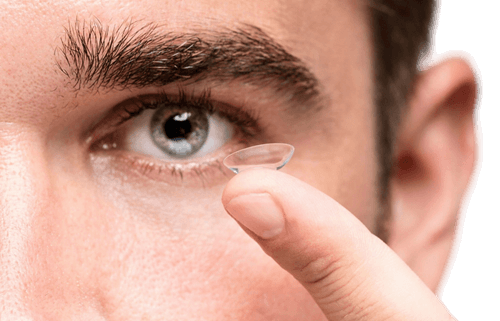
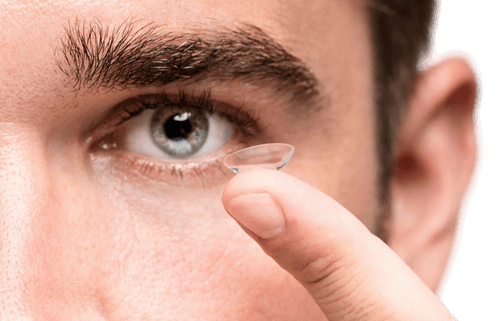
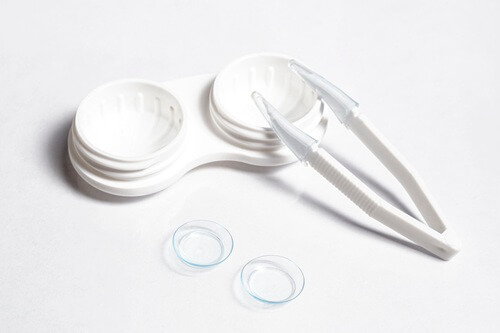
It's a specially designed contact lens that helps you see clearly at near, intermediate and far distances. They uses advanced optical designs to allow you eyes to select the focus you need depending on what you are looking at. There's two types of multifocal contact lens:
Multifocal Contact Lenses are not one-size-fits-all. Trial lenses are usually required, and in some cases, more than one trial may be needed to achieve the most suitable fit and vision. Besides, vision clarity may be slightly reduced in low-contrast or dim environments compared to glasses.
While multifocal contact lenses offer great convenience, it is important to avoid prolonged wear without adequate rest, as eye health should always come first. Keeping a pair of glasses back at home as backup is strongly recommended.
Our Optometrist will carefully recommend the most suitable lens design based on your lifestyle and visual needs.
Method 2 - Multifocal
Contact Lens
Multifocal Contact Lens suits individual who leads an active lifestyle or prefer glasses-free vision.
Lifestyle after Presbyopia
Generally, you can't prevent yourself from getting presbyopia. You can help to protect your eyes and your vision by following these tips :
Annual eyes checkup
Do this regularly even if you see well.Control chronic health conditions
Certain conditions, such as diabetes and high blood pressure can severely affect your vision if you don't receive proper treatment.Protect your eyes from UV
Wear glasses or sunglasses that blocks ultraviolet(UV) radiation. This is especially important if you spend long hours in the sun.Prevent eye injuries
Wear protective eyewear when doing certain things, such as mowing lawn or using other products with toxic fumes.Use good lighting
Turn up or add light for better vision.
"For the first time, I have to take my spectacles on and off - depending on what I'm doing. I've become one of those people who have to lower their specs onto their nose to read......."
FREQUENTLY ASKED QUESTIONS








No 11A, Jalan USJ 1/1A